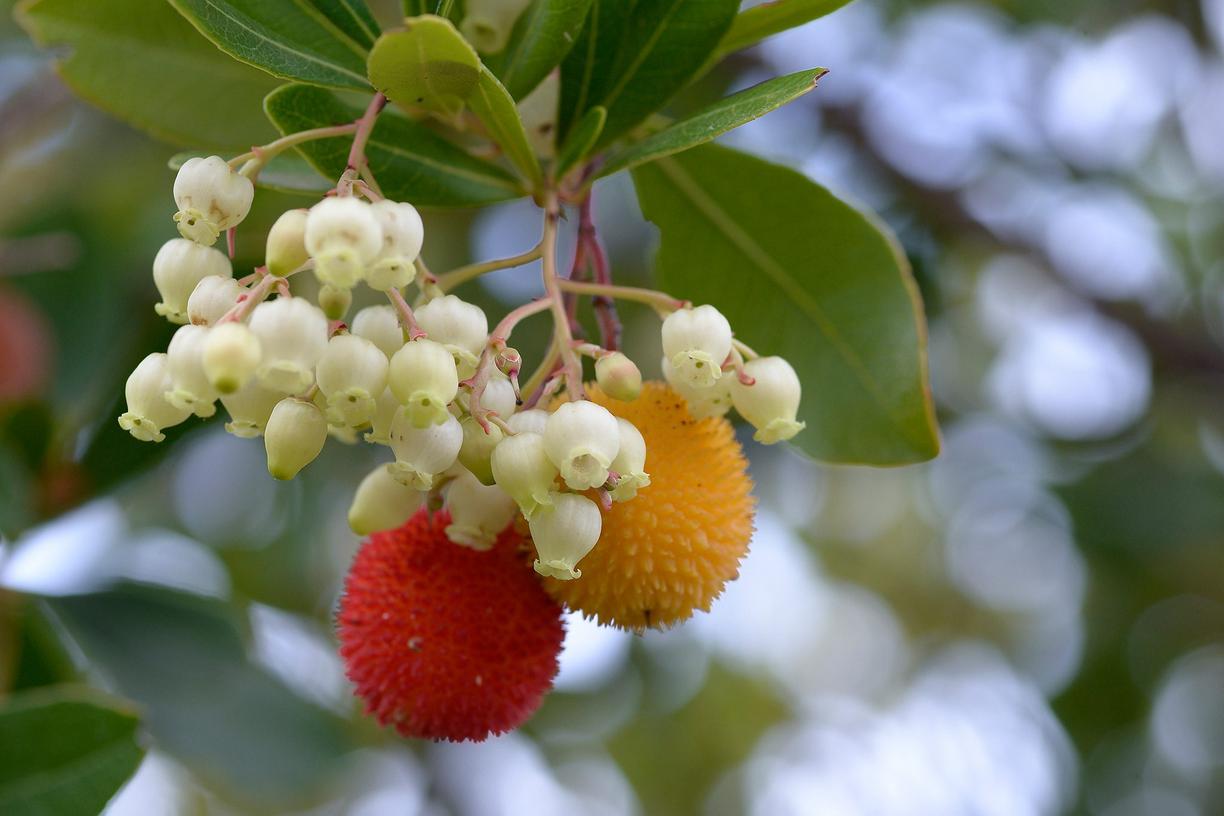
Strawberry tree
Arbutus unedo is a broadleaf evergreen, multi-stemmed shrub with four-season appeal. The attractive bark is greyish-brown which peels and flakes to reveal an inner bark of orangey-red. The glossy, leathery green leaves are alternate and obovate in shape with a serrated edge. Small flowers are fragrant, white-pink, and urn shaped that bloom in the fall to early winter. At the same time, rounded, bumpy, orange-red fruits are ripened from the previous winter allowing the plant to have both flowers and fruit appearing together. Although resembling strawberries in appearance, the fruit are not flavourful. It’s a great shrub for the home garden as it matures to 3 to 5m in height and width. It is native to the Mediterranean and Western Europe where it is found on rocky slopes and shrubland. They make a good choice for the Pacific Northwest garden. It tolerates a variety of soils but must be well-drained. Winter winds can damage the foliage, fruit, and flowers.
| Attribute | Information |
|---|---|
| Family | Ericaceae |
| Origin | Mediterranean Basin and Western Europe |
| Form | Upright spreading, usually multi-stemmed |
| Foliage | broadleaf evergreen, obovate, glossy green leaves with serrate margins to 10 cm |
| Size | 3 - 5 m/ 3-5 m; infrequently grows to 10’ in height |
| Hardiness Zone | 6-9 |
| Flower Colour | Pinkish white |
| Leaf Colour | Dark green leaves |
| Bloom Time | Fall to early winter |
| Soil and Watering | Well-drained soil; Medium to dry, drought tolerant when established |
| Other | Arbutus unedo is in the same family as the native Arbutus Menziesii. Arbutus can regenerate after a fire. It is pollinated by bees, primarily bumblebees, hummingbirds and butterflies. Birds eat the fruit in winter. |
Written by: Cathy Lund, Vancouver Island Master Gardeners Association